
Trailers have specific conventions which make them somehow similar such as the main plot is briefly explained in intertitles. Like the trailer "Creep" the intertitles are shown in a professional font but there is no dialogue over the top of the intertitles. However some trailers have a creepy or scary voice speaking the intertitles as they appear. Trailers also feature the main characters within the movie and parts of their journey in the movie. Some of the clips are main parts of the movie and some are relevant to the title and what the film is about. Some trailers also include cliffhangers so it makes the audience want to see the full movie. Depending on the director and actors, some of them are used as production values to sell the movie. We wanted to keep our trailer as simple as possible so we didn't use dialogue or production values so we only used intertitles which explained the movie.
On the left are stills from our trailer, and on the right are stills demonstrating similar conventions, taken from real horror film trailers.
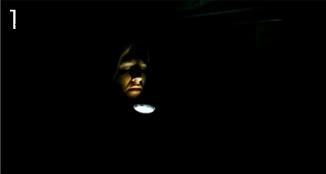
1) This first frame on the right is from the British thriller film "Creep" which is set in the London Underground where a woman gets trapped and cannot get out. This particular frame is shown near the end of the trailer and is part of it's climax. I like this shot because it is the typical thing to do to scare someone as it is unnatural lighting. It is an effective frame because it concentrates on the woman's face and it reflects the horror genre very well.
The frame from my movie is very similar to this as a torch is being pointed up to create a horror effect. We chose to use this frame because we thought it gave a sense of being trapped or not knowing what to do. In 'Creep' the woman is sitting in a corner with the torch pointing up and in our frame the character is laying on the floor with the torch. This shot is very iconic of the horror genre because of the low key lighting and unfamiliar shadows.

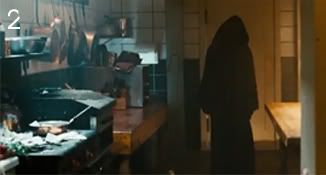
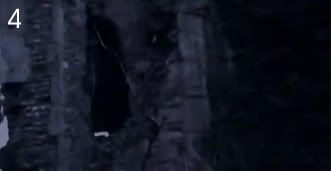
2) This next frame is from a horror/thriller film called "Sorority Row". This film is about a group of girls who play a death prank which goes horribly wrong. The 'monster' in the film wears a long black robe with a big hood like in our film trailer. This particular frame is a long shot of the 'monster' which is standing in the right of the frame. It connotes the horror genre by the dark and mysterious character. This is a typical horror shot because it is a confined space with a long shot. This is almost like a point of view shot which are seen a lot in horror movies.
Our frame is kind of similar to the Sorority Row frame because it is like a point of view shot which is typical to the horror genre. We chose to do this frame because we thought that it would be a very powerful shot. We wanted the audience to sense a feel of being followed or haunted by the Monk. The Sorority Row frame makes the audience feel like they are being chased instead of haunted.

3) The third frame is a running frame from another British thriller film called 'Eden Lake'. Eden Lake is a film we watched in class to understand different types of horror movie and class of people. This is a horror movie which is about a couple who are being intimidated by young teenagers who have grown up in an unstable family. The main protagonist is the girlfriend who is forced to fight for her own life. This particular shot is shown her running away to find help. This is an effective shot because it shows a full perspective of what the protagonist is running from. This is typical of horror movies because it shows that they are lost and not sure where to go.
We also used a similar shot but it was used as a point of view / handheld shot where two people were running and one was holding the camera however the one in Eden Lake was a fixed camera angle and position. The handheld shot signifies the horror genre because it puts the audience in the perspective of the person. This creates a sense of mystery and suspense for the audience. The setting within the Eden Lake frame is shot within an enclosed forest whereas our frame is shot at an open wide graveyard. We thought a graveyard was appropriate because it fit well with our theme of a Monk.
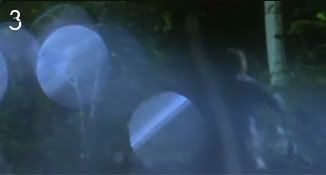
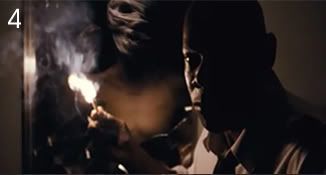
4) This shot is quite difficult to show in a frame because in the trailer for the horror movie 'Devil', this frame only appears for a split second making it the climax of the trailer. Showing frames for a short amount of time surprises the audience. This also sticks in the audience' mind so they will want to see the movie. The particular shot is powerful because the 'monster' is shown by a small flame. The guy who has the lighter is also unaware of the 'monsters' whereabouts.
We also used a similar shot to this where the 'monster' is shown for a very short amount of time which has also been done in a handheld shot. We wanted to create the effect where a character fell over with a camera and by accident caught the monk on camera. This kind of shot is used in the same way to surprise the audience and remember the trailer they saw. Both of these shots show binary oppositions with good/evil. The good people are being haunted or stalked by the evil within the same frame.
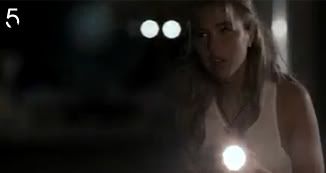
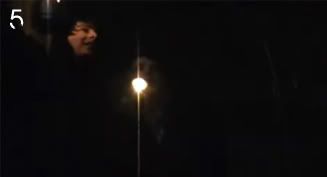
5) This frame is from a horror film trailer which I cannot remember the name but the main protagonist is a woman who is trying to save her friend. This particular frame is used to create a sense of the character being lost and using a torch for self-reassurance. When a torch is used in a horror film, it can be a tool to distract the audience from any 'dangers' within the film and it could also reassure the audience however in horror films, anything could happen at any time. Settings are dark when torches are used and dark settings are very commonly used in horror films. The dark settings also connote the horror genre.
We also decided to use this type of shot because we wanted to create a sense of being lost. The frame is very dark which creates an effect of being trapped or being lost too. The camera angle within this frame is also slightly canted. This creates an effect of unfamiliar and strange surroundings which is also very common within horror movies.
The horror genre also uses very expressive camera work by creating an atmosphere, suspense and tension just by using the camera. By hiding certain parts of a frame can create a real expression in the movie. The camera work in a horror movie is as important as the actors or even the set.
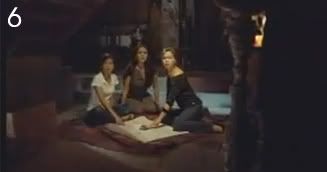
6) This last frame is a frame which is from a film called 'Ouiga' where a group of girls use a Ouiga board and get haunted by evil spirits. This particular frame from the film shows a group of girls looking towards the camera after doing the ouiga board. This shot shows that they have heard or seen something at the corner of their eye and looked in a particular direction. This shows that they are worried and scared. This shot is also hiding the 'danger' which gives the audience a sense of mystery and "what's going on?"
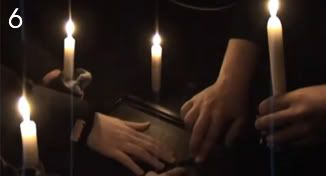
We also used a similar frame but a close up of the ouiga board. Within our trailer, the soundtrack hints at something happening. We do not show the surroundings as it gives the audience a hint as to what is happening. We wanted to keep the 'danger' as the mystery to the audience. The candles also create a sense of an old and creepy effect whereas the one from 'Ouiga' does not have candles and uses artificial lighting.

4) This shot is quite difficult to show in a frame because in the trailer for the horror movie 'Devil', this frame only appears for a split second making it the climax of the trailer. Showing frames for a short amount of time surprises the audience. This also sticks in the audience' mind so they will want to see the movie. The particular shot is powerful because the 'monster' is shown by a small flame. The guy who has the lighter is also unaware of the 'monsters' whereabouts.
We also used a similar shot to this where the 'monster' is shown for a very short amount of time which has also been done in a handheld shot. We wanted to create the effect where a character fell over with a camera and by accident caught the monk on camera. This kind of shot is used in the same way to surprise the audience and remember the trailer they saw. Both of these shots show binary oppositions with good/evil. The good people are being haunted or stalked by the evil within the same frame.

5) This frame is from a horror film trailer which I cannot remember the name but the main protagonist is a woman who is trying to save her friend. This particular frame is used to create a sense of the character being lost and using a torch for self-reassurance. When a torch is used in a horror film, it can be a tool to distract the audience from any 'dangers' within the film and it could also reassure the audience however in horror films, anything could happen at any time. Settings are dark when torches are used and dark settings are very commonly used in horror films. The dark settings also connote the horror genre.
We also decided to use this type of shot because we wanted to create a sense of being lost. The frame is very dark which creates an effect of being trapped or being lost too. The camera angle within this frame is also slightly canted. This creates an effect of unfamiliar and strange surroundings which is also very common within horror movies.
The horror genre also uses very expressive camera work by creating an atmosphere, suspense and tension just by using the camera. By hiding certain parts of a frame can create a real expression in the movie. The camera work in a horror movie is as important as the actors or even the set.

6) This last frame is a frame which is from a film called 'Ouiga' where a group of girls use a Ouiga board and get haunted by evil spirits. This particular frame from the film shows a group of girls looking towards the camera after doing the ouiga board. This shot shows that they have heard or seen something at the corner of their eye and looked in a particular direction. This shows that they are worried and scared. This shot is also hiding the 'danger' which gives the audience a sense of mystery and "what's going on?"
We also used a similar frame but a close up of the ouiga board. Within our trailer, the soundtrack hints at something happening. We do not show the surroundings as it gives the audience a hint as to what is happening. We wanted to keep the 'danger' as the mystery to the audience. The candles also create a sense of an old and creepy effect whereas the one from 'Ouiga' does not have candles and uses artificial lighting.


This is very good overall, although sometimes you need to say more about particular conventions for example your handheld point of view staff really needs further discussion so that you can explain how such point of view camerawork generally operates in horror and how it is a key convention of the genre. Similarly when you mention canted angles you should perhaps here discuss the idea of expressive rather than naturalistic camerawork in the genre in general.
ReplyDeleteThe biggest thing that is missing here is any discussion of trailer conventions rather than horror conventions. You will need to add something about these.
In terms of layout it would read more easily if each of the image pairs was immediately above the text that discusses them.